Contents
Landmark discoveries
A dated path. Each stop is a result someone else could build on, not a statue.
Dates below are the dates of the public work. The private struggle was usually longer. Where several people made the result, several people are named.
Seeing the very small
In 1665 Robert Hooke’s Micrographia showed cork as a honeycomb of “cells,” a word borrowed from the rooms of monks. He was looking at walls. In the 1670s Antonie van Leeuwenhoek, grinding his own lenses in Delft, saw living animalcules in water, and in 1683 described bacteria from the plaque of his own teeth. The world had been populous the whole time. We had lacked a lens.
The cell theory proper waited until the nineteenth century, when improved optics and staining made nuclei and division visible enough to argue about. Discovery here was an instrument plus a willingness to believe the instrument.
Descent with modification
On 1 July 1858 the Linnean Society of London heard a joint presentation: Alfred Russel Wallace’s manuscript from the Malay Archipelago, and extracts from Charles Darwin’s unpublished essay and a letter. On the Origin of Species followed in 1859. The claim was not “animals change.” Breeders already knew that. The claim was that a natural filter on heritable variation, continued for long enough, produces the fit between organism and place, and that living species are branches of one genealogy.
The mechanism of heredity was the hole in the theory. Darwin never saw Mendel’s paper. That missing piece is why the rediscovery of Mendel in 1900 changed the argument instead of merely decorating it.
A particulate heredity
Gregor Mendel counted pea offspring across generations and inferred factors that separate and rejoin, rather than a fluid that blends away. He reported the work in 1865; the paper is 1866. In 1900 Hugo de Vries, Carl Correns, and Erich von Tschermak, independently enough to be awkward about it, brought the paper back. Thomas Hunt Morgan’s fruit-fly group then put genes on chromosomes and made linkage a map.
Mendel’s luck with the traits he chose was real. So was his discipline with numbers. The experiment page treats the crosses as an experiment rather than a myth.
Germs, demonstrated
Louis Pasteur’s swan-neck flasks, around 1859–1861, showed that boiled broth stays clear until dust is allowed to reach it. Spoilage was not a spontaneous appetite of the liquid. Robert Koch’s work on anthrax, tuberculosis (1882), and cholera tied particular microbes to particular diseases and, with Friedrich Loeffler and others, set the standard of evidence later called Koch’s postulates.
The postulates are a logic, not a cage. Viruses, asymptomatic carriers, and bacteria we still cannot culture all strain the original rules. The demand for a specified cause survived the strain.
The molecule of inheritance
In 1928 Frederick Griffith found that something from dead virulent bacteria could make a live harmless strain virulent. In 1944 Oswald Avery, Colin MacLeod, and Maclyn McCarty argued that the transforming substance was DNA. Many researchers still suspected protein. In 1952 Alfred Hershey and Martha Chase showed that the phosphorus of phage DNA, not the sulfur of phage protein, enters the bacterium and drives the next generation of phage.
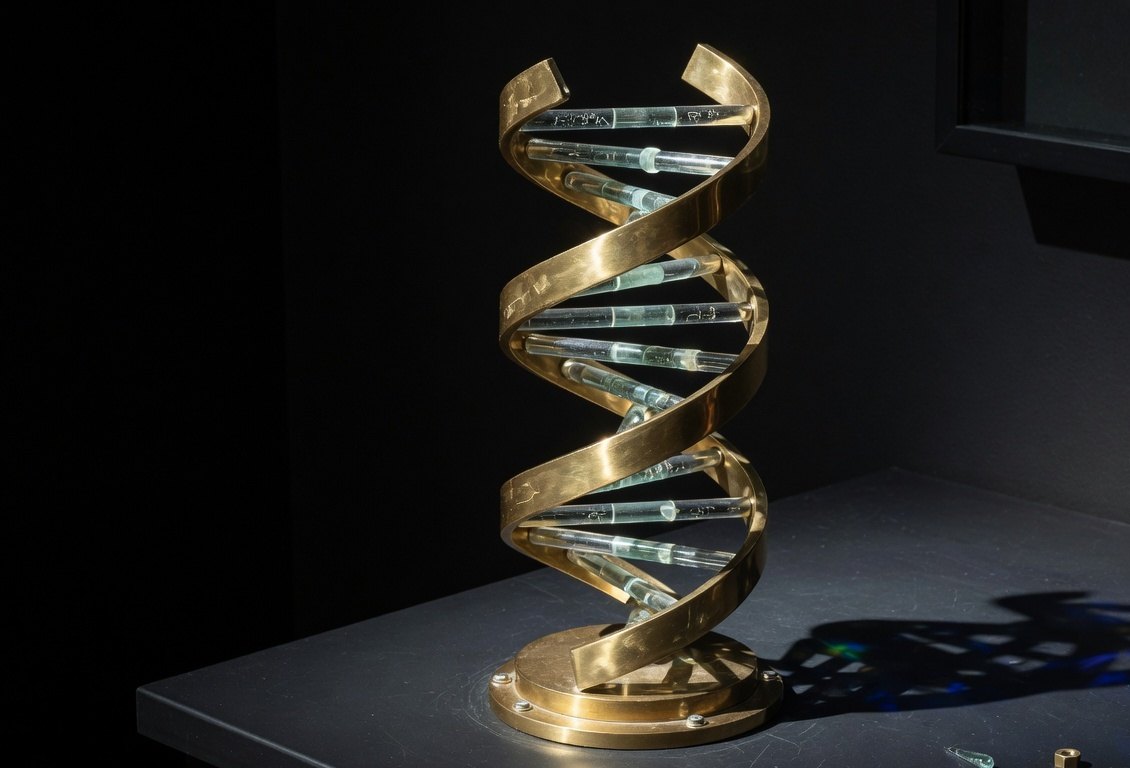
In 1953 James Watson and Francis Crick proposed the double helix. Maurice Wilkins, Alec Stokes, and Herbert Wilson supplied diffraction evidence. Rosalind Franklin and Raymond Gosling’s paper carried Photo 51’s implications: a helical structure with the phosphate backbone outside. Erwin Chargaff’s base ratios (adenine with thymine, guanine with cytosine) were already on the table. The model mattered because the strands suggested a way to copy.
Code, sequence, and a third domain
In 1961 François Jacob and Jacques Monod described the operon: genes switched as a group by a repressor. The same era cracked the code. Marshall Nirenberg and Heinrich Matthaei showed that poly-uracil RNA makes poly-phenylalanine. Har Gobind Khorana’s synthetic messages assigned the triplets systematically. Robert Holley sequenced a transfer RNA. The three shared the 1968 Nobel Prize.
Frederick Sanger sequenced insulin in the 1950s, then DNA. His chain-termination method, published in 1977, made genomes legible. The same year Carl Woese and George Fox used ribosomal RNA to show that the “bacteria” included a second, fundamentally distinct group. We now call them archaea. The tree of life gained a trunk nobody had budgeted for.
In 1983 Kary Mullis conceived the polymerase chain reaction. Heat-stable polymerase from Thermus aquaticus, a bacterium Thomas Brock had studied in hot springs for its own sake, made the reaction practical. The Human Genome Project, launched in 1990, published a working draft in 2000 and a finished reference in 2003. A complete telomere-to-telomere human sequence arrived only in 2022. “The genome” was never a single afternoon.
Recent landmarks you will still be quoting
Barbara McClintock’s mobile elements in maize, demonstrated across decades and recognized with a Nobel Prize in 1983, showed that a genome is not a fixed string. Lynn Margulis (publishing first as Lynn Sagan in 1967) pushed endosymbiosis until the evidence — genomes inside mitochondria and chloroplasts — made it ordinary. In 1996 the Roslin Institute’s Dolly, a sheep cloned from an adult cell nucleus, showed that a differentiated nucleus could still direct a whole development. She was announced in 1997.
In 2012 Martin Jinek, Krzysztof Chylinski, Ines Fonfara, Michael Hauer, Jennifer Doudna, and Emmanuelle Charpentier described a programmable CRISPR–Cas9 cut. Doudna and Charpentier received the Nobel Prize in 2020. Svante Pääbo’s group built a discipline of ancient DNA and a Neanderthal genome; he received the Nobel Prize in 2022. Katalin Karikó and Drew Weissman’s modified messenger RNA, work of the 2000s, became the basis of COVID-19 vaccines authorized in 2020; they received the Nobel Prize in 2023.
None of these were solo performances. The pages on contributions and serendipities name more of the chain.